English
By the time children leave Forty Hill CE Primary, we expect our pupils to be able to communicate through speaking and listening, reading and writing. With confidence, fluency and understanding. This will enable them to continue their life-long learning journey, within the wider world.
EYFS Click Here
KS1 Click Here
Lower KS2 Click Here
Upper KS2 Click Here
Click here for English Writing Planning Progression Map
Click here for English Progression of Genre
Click here for Progression in English
Click here for Writing Texts Type Progression


Click here for The Literacy Shed
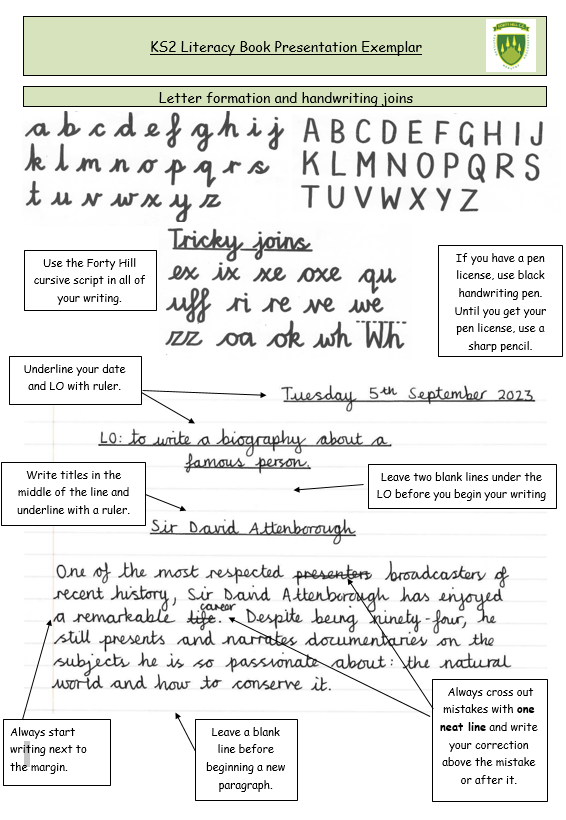
Our Writing Exemplar – KS2
In KS2, we help children become confident, creative and independent writers. We use high-quality books and texts to develop their vocabulary, grammar, imagination and writing skills.
Children learn to write different types of texts, including stories, descriptions, reports, poems and persuasive writing. Teachers use examples, modelling and discussion to help children understand how to write effectively.
We use a range of activities to support writing, including:
-
drama and role play
-
discussion and debate
-
story maps
-
teacher modelling
-
shared and guided writing
-
drafting, editing and improving work.
We also use Talk for Writing. Children learn a model text using actions and story maps, explore the language and structure, practise writing skills and then use what they have learned to create their own independent writing.
Writing is encouraged across the curriculum, including Science, RE, History and Geography. Technology is also used where it supports learning.
Children are taught spelling rules and patterns for their year group and practise these through spelling, writing and handwriting activities.
Our aim is for all children to enjoy writing and become confident writers who can share their ideas clearly and creatively.
Our Writing Exemplar for Children in KS2
Phonics
At Forty Hill School, we use Little Wandle Letters and Sounds Revised to teach children phonics. We believe every child can learn to read and write.
Nursery
Children develop early reading skills through:
-
songs and rhymes
-
stories and books
-
listening games
-
oral blending
-
speaking and listening activities.
Reception and Year 1
Children have daily phonics lessons where they learn letter sounds and practise blending them to read and spell words.
-
Reception learns Phases 2–4.
-
Year 1 reviews these phases and learns Phase 5.
-
Children take the Phonics Screening Check in Year 1.
Reading Practice
Children read in small groups three times a week using books matched to their phonics level.
They practise:
-
reading words
-
reading with expression
-
understanding what they read.
Children who need extra help receive additional reading and phonics practice.
Reading at Home
Children take phonics books home to practise with their families. They can also choose books to enjoy at home.
We work closely with families to support children’s reading development.
Our aim is for every child to become a confident and enthusiastic reader.